Form-find it, pattern it, and cut it from one geometry.
For the people who design and make fabric structures. The seams are decided first, the mesh is built panel by panel, and the cutting pattern is developed from the analysis mesh itself — so the cloth you cut and the surface you analysed are not two models that have to be reconciled.
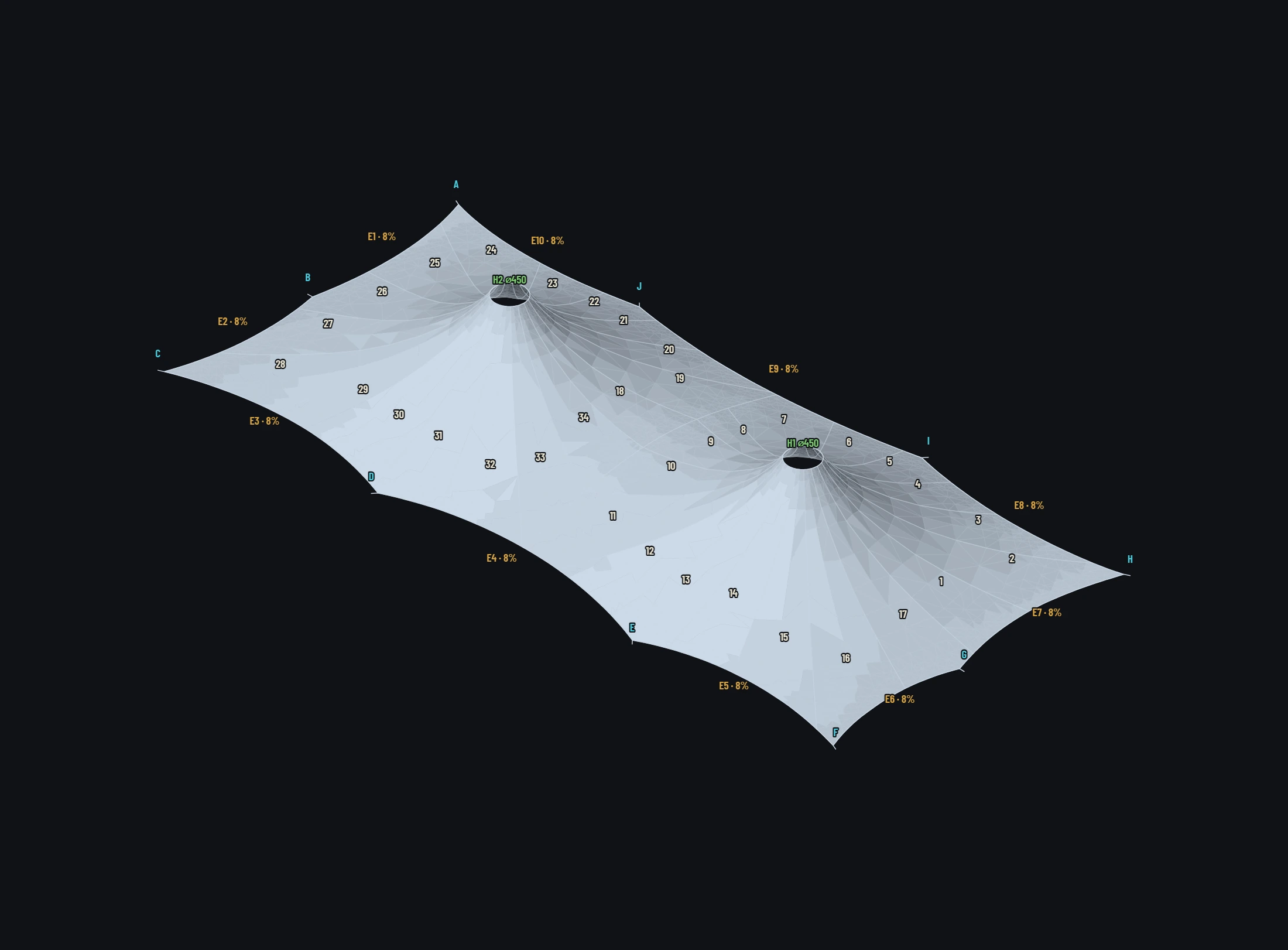
Step one§4
Place it, and let it find its shape.
A sail is placed on three or more corners, anywhere in 3D, with warp and weft angles and a prestress each way in kN/m. Form finding runs by the force density method, off the main thread, so the drawing stays usable while it settles.
- Sail placed by three or more points, corners anywhere in 3D; warp and weft angle; prestress each way in kN/m; edge sag as a percentage, or supported.
- Form finding by the force density method, non-blocking, with progress shown over the centroid; mesh refined automatically and element quality reported.
- 3D catenary edges; edge cables with profiles; under-fabric cables with sag, reversible; high points with a diameter and their own grips.
- A drape object — form found by hanging, with self weight and sag controls rather than prestress. coming
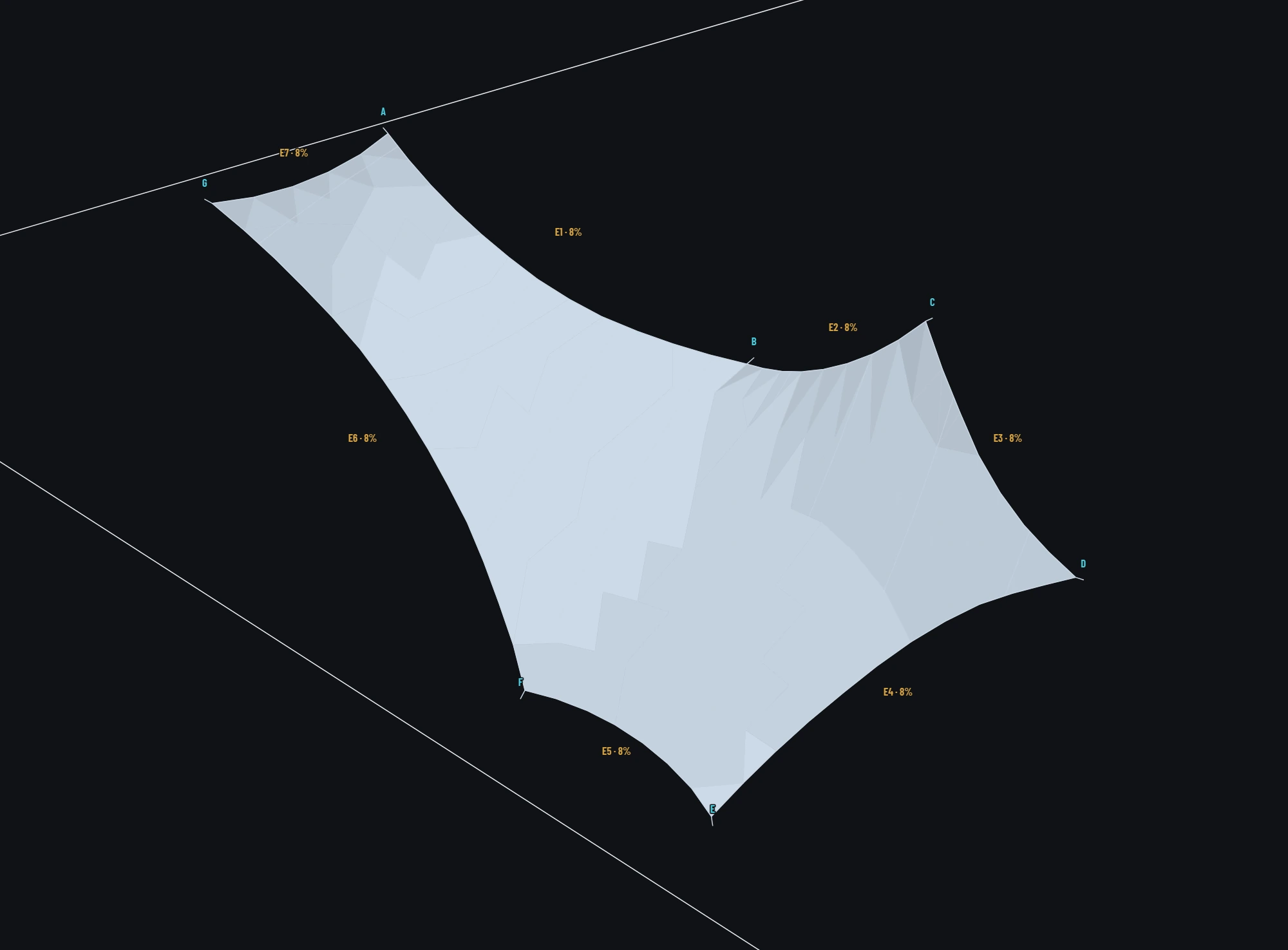
Step two§4
The panels are the blocks.
Where a sail has high points it is patterned by Voronoi cells and meshed as block-structured quads — one block per panel, tied node-for-node on the seams and nowhere else. A sail without high points is patterned rectangularly on the unstructured mesh. There is no setting: the geometry decides, and where a block layout cannot be laid the app declines and falls back rather than approximating.
- Seam lines at the roll width, with a patterning set-out point and offset.
- Panels developed from the FE mesh: best-fit plane, then relaxed onto the true element edge lengths, worst edge strain reported.
- Measured on the two sails we publish: a 9 × 7 m hypar develops 48.27 m² against a surface of 48.29 over 3 panels, worst edge strain 0.41%; this canopy develops 82.19 m² against 82.20 over 28 panels, all inside the roll, worst panel RMS flattening strain 0.14%.
- Radial patterning on geodesics is not finished: on a 12 × 10 m conic sail it gives 20 panels with the area exact and worst strain 0.99%, but the panel edges follow mesh triangles to within one element of the geodesic instead of being cut on it, and a corner panel wider than the roll is flagged, not split into a second ring. coming
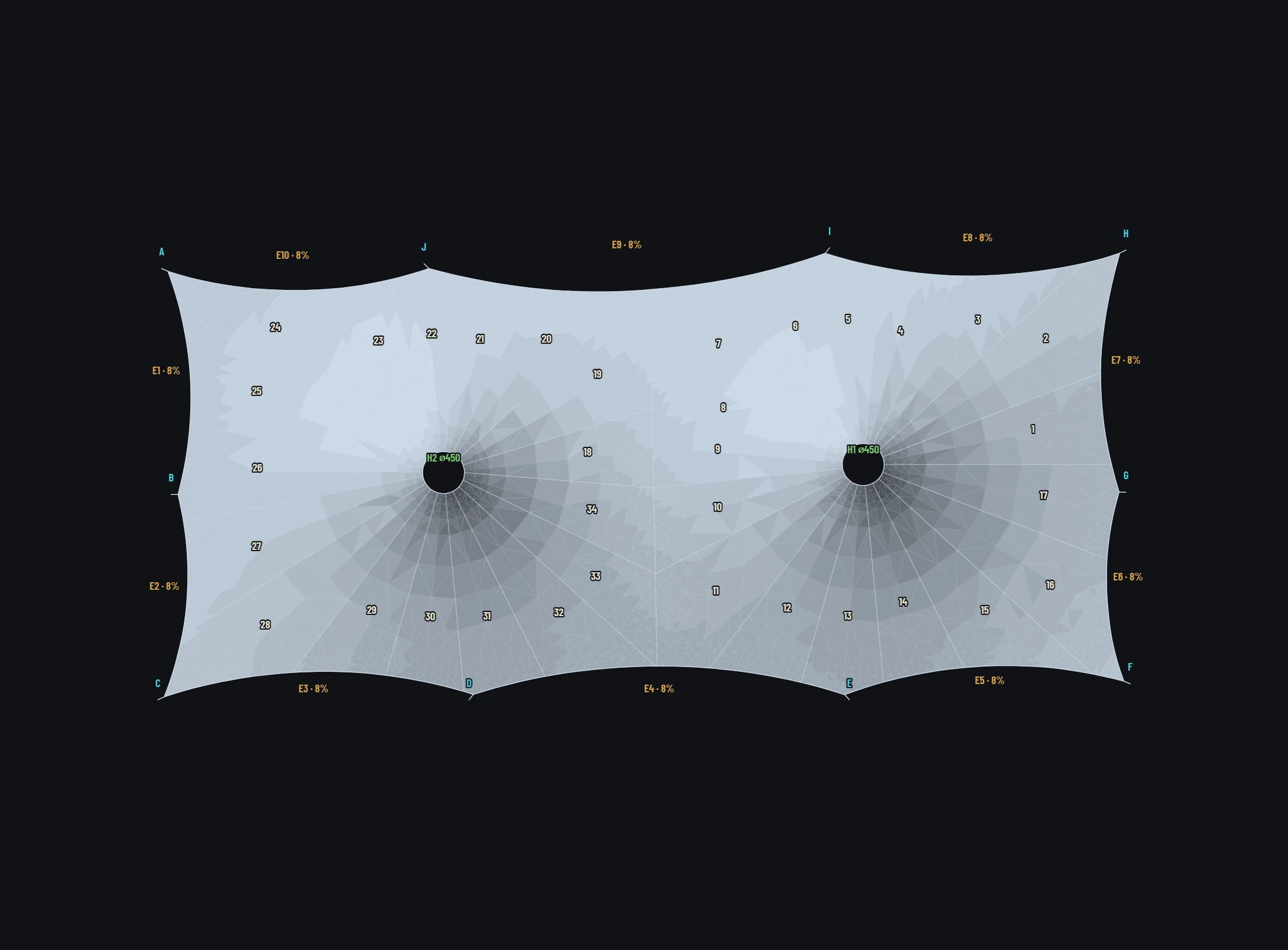
Step three§4
Every force, where the force is.
The corner fitting is a real element: the anchor is fixed, the membrane corner is a free plate on a link, and the corner offset is that link’s length — its direction comes out of equilibrium as the resultant of the two edge cables and the fabric. Set the offset to zero and the corner is genuinely pinned.
- Edge cable tension at each end and its maximum; corner link force with bearing and inclination in the site frame — the anchor reaction is equal and opposite; the realised warp and weft stress.
- Self-checks every solve, with the numbers stated: equilibrium residual 5.8e-14 on the 9 × 7 hypar and 1.7e-12 on the canopy, against a 1e-6 limit; every link on its resultant to 0.00000°; link length against the asked offset within 0.09 mm.
- Realised prestress reproduces what was asked to 0.08% warp and 1.64% weft on a regular lattice. It does not on a graded panel lattice: on this canopy the weft reads 24.4% low, because the mesh is form-found free and its lattice slides off the one the densities were set on. Measured, explained and quantified in VERIFY.md — not fixed. coming
- Independent verification against RFEM. The inputs to reproduce both sails are published; the comparison has not been run. coming
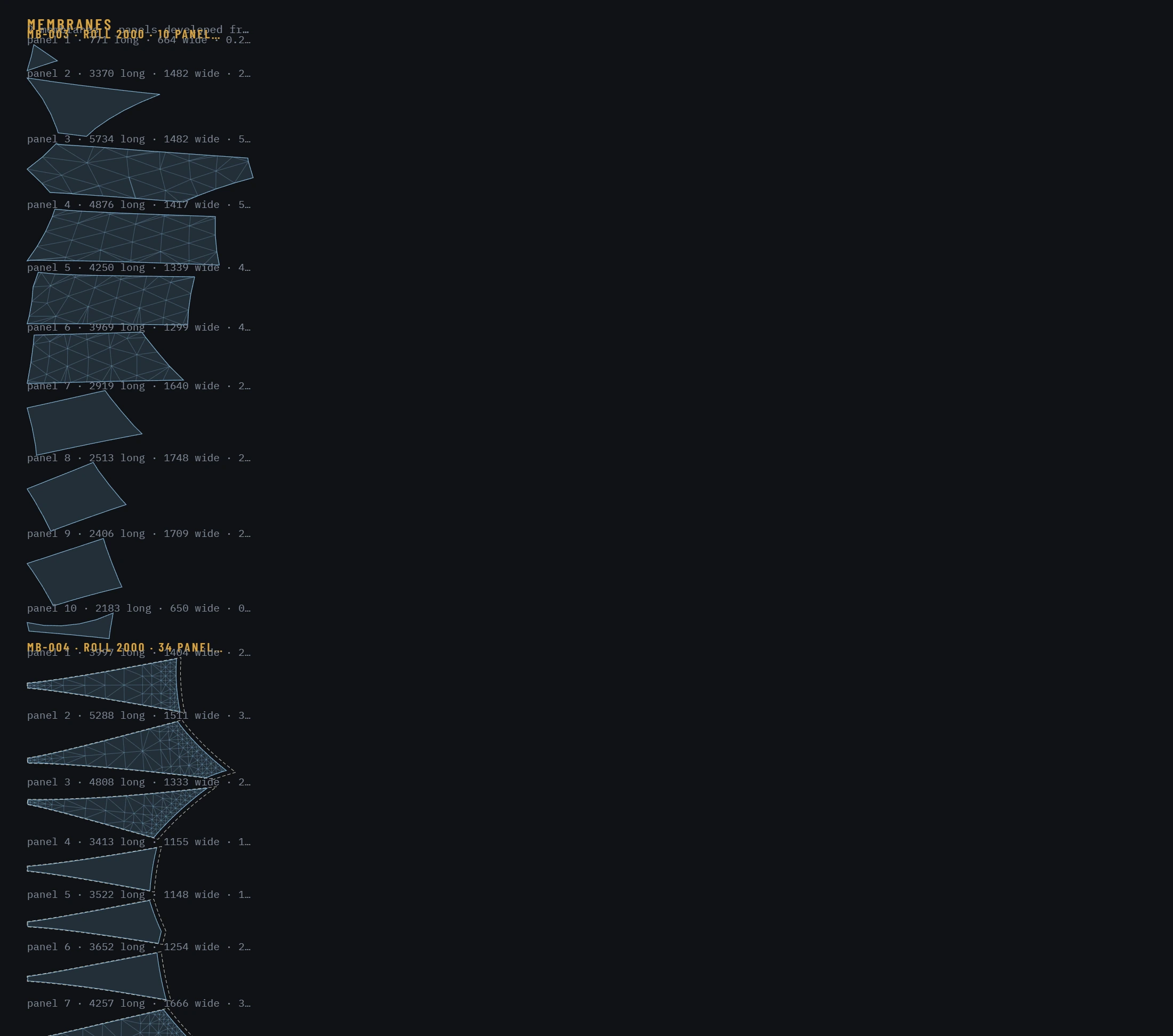
Step four§6, §7
Off the roll, onto the floor.
The developed panels go into the same knolling view as the plates and the members: nested on the roll, numbered with the numbers that are already on the cloth, and out as DXF, SVG or a cutting list.
- Membranes as developed panels in the knolling view, beside plates nested on standard sheets and members as a cutting list, longest first.
- The panel numbers on the cloth are the numbers the knolling and the cutting list use.
- DXF with a layer per material and thickness, SVG, and the cutting list as CSV.
- The high point ring as true circle geometry, with rotation in two directions and local refinement. coming
Tell us what you make.
If you pattern fabric for a living we want to hear where this breaks. Requests are read by a person.